Wednesday, May 12, 2010

Tastes of Heaven

Now that we are finally coming into warm weather you can really start to see the transformation of my specials, not only due to the availability of fresh, new ingredients like spring onions, spring garlic, peas, fava beans and asparagus, but also because of I have to cater to the perception of a dish, which means that sure, I can serve a braised meat in the middle of summer, but no one will order it because it seems too heavy and rich to eat on a warm, sunny day. I say perception because, after all, we eat what we want when we want; many people eat ice cream in the winter and hot soup in the summer.

So, as a part of this glorious time of ingredient revival, I am going to use a combination of fresh vegetables with a simple olive oil dressing to lighten up handmade whole wheat pasta.

I don't need to reiterate my love for pasta and noodles, but it is important to note that what I am looking for when eating/making them is a certain amount of chew, and I have found that the easiest way to achieve that texture is by using whole wheat flour.

At home I buy dried whole wheat pasta not just for nutritional value, but because it is the easiest way to end up with that traditional "al dente" bite, but I cannot bring myself to feature store-bought pasta for my weekly special, so, once again, I return to the faithful Kitchenaid pasta roller-and-hand-cut technique. Maybe someday I will actually invest in a pasta cutter attachment as well, but until then...

I made a dough of equal parts whole wheat flour and all purpose flour to get the best of both worlds: the nutrition and heft of the whole wheat along with the ease and stability that refined flour offers. In between the rolling, resting, cutting and cooking of the pasta making process I gathered the accompanying ingredients.

As a simple yet flavorful sauce I began by slowly simmering spring onions and garlic in extra virgin olive oil until they were soft before adding ground Linguiça, a Portuguese sausage that is cured with paprika and garlic before being smoked. Once the sausage had infused the oil with its essence the sauce took shape with a little white wine reduction and the addition of spring onion greens and finely diced tomato.

The only problem is that, as with most pasta dishes, this one lacked texture, even with the thick-cut whole wheat noodles, so to top the dish off I took pieces of the braised pork belly that's on our menu and stewed them down until all of the fat is cooked out, ending up with a light (dare I say angelic?) and crunchy version of pork that is so fine that it melts in your mouth!!


I have to let you know that the Cinnamon Pear Martini made with my own cinnamon-infused tequila and a fresh pear sorbet that was last week's drink special was HANDS DOWN the best selling cocktail special that I have offered to date, with an outcry for menu status, and not just from Paul and Chie, some of our faithful Wednesday night regulars.

So considering that, if I had tried to match - let alone beat - last week's drink special, I would have driven myself crazy, so I simply put it out of my mind and started fresh. Once I did that, a good idea just came naturally. Funny how that works, isn't it?

To welcome this beautiful weather I am offering this concoction that is full of bright and fresh flavors to ease you into this sunny transition.

First, we muddle fresh mint in a little bit of ice in a pint glass, then add freshly juiced cucumbers, a splash of simple syrup, Plymouth Gin - a perfect marriage for cucumber - and a nice amount of club soda for added refreshment.

Hopefully we'll be opening up our patio this week; what would be a better drink inaugurate the opening of our big front doors.

With Love,

Cheffrey


Wednesday, May 5, 2010

Friends of Mine

In the spirit of the season I wanted to continue using local asparagus during this short window that it's available so I chose to do a variation of a dish that I co-created with my friend and colleague, Tommy Lee, that originally consisted of an asparagus and goat cheese flan with roasted quail and a lingonberry preserve. I really loved the way that sweetness of the preserve interacted with the rich flan, so my inspiration for this week's dish started there.

I kept with the original flan recipe by finely chopping asparagus and pureeing it in a blender with boiled cream and chevre goat's cheese. I strained the mixture before whisking it into whole eggs and slowly baking it into individual molds. As for the preserve I went with a more local variation by simmering rhubarb in sugar, lemon juice and red wine until it was thick and pulpy. The combination was as good if not better than the dish that I remember - the tart rhubarb seems to have added another contrasting flavor to the flan.

Despite being one of my personal favorite forms of poultry, quail is neither popular among the general public nor cheap so I went with something similar in size: the Cornish game hen. Though called a "game hen", it is actually just a young chicken that can be either male or female. I love roasting them whole at home because they are the perfect size for one portion, but at the restaurant it would take too long to cook them that way, so I butchered them down into quarters, leaving the first wing bone attached to the breasts for presentation and added flavor. I saved the breasts to be cooked to order, but I roasted the legs ahead of time so that I could remove the meat and shred it for another component to the dish.

To assemble the dish I sear the breasts skin side down in clarified butter and toss the pan into the oven to crisp the skin before turning them over to cook evenly through. While the breasts are in the oven I heat another saute pan with more clarified butter which I use to brown slices of steamed fingerling potatoes, hon shimeji mushrooms, chives and the reserved leg meat. When the breasts are cooked I place the cold flan in the center, representing the inspiration and focus of the dish and start building from that; lining the plate with the potato-mushroom saute on either side and layering the room temperature rhubarb compote under the breasts.


Now that I am starting to become known for my themed specials, you would think that I would jump at the chance to come up with some sort of Cinco de Mayo-inspired special, but even though this cocktail is made with tequila, it's far from anything that you'll find south of the boarder.

A couple of weeks ago I decided to take a gamble and start an infusion by combining cinnamon sticks and silver tequila. I wasn't sure what I was going to make with it let alone how well our customers will respond to it, but I knew it was going to be interesting. After poaching pears for the French toast topping last weekend, I realized the perfect pairing.

By poaching ripe pears (which I normally don't do because they are already soft) in honey, lemon juice and water I ended up with a cooking liquid that had inherited all of those flavors, which made for a excellent companion for the cinnamon infused tequila; so complex and intriguing. But then I had the leftover pears, so I thought "If you can put ice in a cocktail and allow it to melt, then why not a sorbet that reinforces the flavors as well!" By pureeing the pears in the cold cooking liquid and churning it in my ice cream machine I ended up with the perfect substitution for ice for this cocktail!
Come in an have a try - you'll be surprised how much you like it, and I can guarantee that you won't find anything like it anywhere else!!

With Love,

Cheffrey

Tuesday, April 27, 2010

Taking the Easy Way Out

Before I get into this week's specials I want to make sure that everyone knows that this Thursday, April 29 is Dining Out for Life, an annual fundraising event where 30% of sales from participating businesses (like ours) goes to Lifelong AIDS Alliance and the fight against illness and hunger in our community. We urge you to make your purchases/dinners at one of the businesses involved, even if it isn't ours.

~~~ ~~~ ~~~

As much as I love the bounty that this time of year begins to offer, there are a handful of ingredients that I can only use once a year despite availability because they are not only pricey, but also a pain in the ass to prepare, like pearl onions, English peas, and the bitch of them all - fava beans. Not only do I (and our customers) have to pay for the inedible shells, but in the case of the fava, each bean needs to be peeled individually in addition to shucking them from the pod. Fortunately for me (and our customers), a little complaining has paid off.

During a delivery last week my produce purveyor, Aaron pointed out that fava beans were around, and after my expletive-filled rant about time and money, Aaron offer the idea to try fava leaves, suggesting that they are "all of the flavor without any of the hassle".

After some research I found that they have become popular in San Francisco due to a high volume of crops around that area, and they can be served raw in a salad or sauteed like spinach; either way yielding the same, full flavor of fava. Due to their obscurity I wasn't able to guarantee that I would be able to get the fava leaves in again, so after experimenting a little bit on my own I found a base for my special, as well as a sigh of relief.

I wanted to make a thick puree, so I started by sweating onions and garlic in olive oil to which I added not only the picked fava leaves, but I also pureed the stems in a blender with some half and half that I strained before adding to the mix to draw out as much flavor as possible without the final product coming out chunky. Once the leaves were wilted in the enriched cream I quickly returned the mixture to the blender along with a few cooked potatoes for a thicker, silkier texture. As soon as everything was completely homogeneous I quickly chilled it over ice to ensure that the bright green color stayed intact.

To accompany the fava flavor I decided to go with the mediterranean ideal that has been associated with it, so I chose another legume as a playful sort of irony to pair with it: the scarlet runner bean. Named after the color of flower that it often yields, these are probably the largest that you have ever eaten, swelling to just over an inch in my kitchen, but not before imparting more flavor by simmering them for over three hours in a combination of vegetable stock and Ras el Hanout, a North African blend of spices containing cardamom, clove, cinnamon, coriander, cumin and other spices. I love cooking dried beans this way because it imparts the flavor throughout, not just on the surface.

I've had an idea in my notebook for quite some time now to stuff pork tenderloins with figs, and I felt that there would be no better combination than with the flavors of this dish, and if I was going to take it that far, I might as well add crumbled Gorgonzola cheese to the stuffing as well; you know, for good measure.


Lately I've felt that my background in pastry has been advantageous in this quest for new and different cocktails; that my experience in both sides of the kitchen (sweet and savory) gives me an edge over the usual mixologist, both in creativity and experience, and I think that this drink proves it!

Instead of the boring staple of simple syrup that some bars even buy (it's sugar and water!!!) I wanted to make a different version consisting of brown sugar, water and a fresh vanilla bean to end up with a component that is much more complex than something most people are used to. I used this to sweeten a passion fruit puree into a perfect balance of sweet and sour, and once combined with Bacardi rum (my favorite mixing rum) and poured over iced this drink has nuances that will float on for days!!!


With Love,

Cheffrey

Wednesday, April 21, 2010

A Taste of the Season

As the days grow longer and the temperature begins to rise, the signs of spring spark new life into everyone and everything. It's times like these when the seasons truly change where I rub my hands together in anticipation of the coming bounty like some culinary villain plotting my attack to take over the world, but it isn't money or gold that I'm after - it's that next great dish!

As certain ingredients come into season I now have to anticipate how I'm going to use them because some have such a short window of availability when sourced locally, which allows for ultimate freshness and natural ripening. Case in point: Asparagus. Since we only have a month or two of true asparagus season here I have to implement it as much as possible without exhausting the customers. I don't plan on featuring it every week (except for our vegetable du jour), but I want to show it's versatility as much as possible while I still can.

Like this week's special, for example; I wanted start the season off right by showing two very different ways to use asparagus, one of which is less common...

In order to emphasize contrast with this special I chose to first use white asparagus, which is the same as "green" asparagus but as the spears shoot up, farmers cover it with dirt so that it grows without sunlight, thus preventing the plant to produce chlorophyll (responsible for the green color) and yielding a more subtle and tender version. Famous for my soups (as any good chef should be), I simmered the white stalks with onions and garlic that were softened in extra virgin olive oil and a couple of peeled potatoes that, when blended, helped create that silken texture without adding cream that I am known for.

To accentuate the soup I needed to offset the creaminess by hand-making a sausage that is full of flavor by creating a sausage that is inspired by types of Hungarian sausages known as Kolbasz. I wanted to come up with something unique, though, so I retooled the flavors of those sausages to come up with a rich and flavorful version that was also easy to make, and since pork is the typical medium for sausages I decided to go a step further and make mine from freshly ground wild boar because it can stand up to the addition of rich ingredients like paprika, smoked paprika, alderwood-smoked salt, allspice, garlic and my own personal touch: amber beer.

I added a few more tastes of local ingredients by sauteing the sausage in a confit of spring onions and garlic with some local purple fingerling potatoes, and (as long as they're still available) more of those black trumpet mushrooms that I absolutely love from last week's special. For that contrast I spoke of I topped the soup off with an unusual preparation of green asparagus by shaving it finely with a vegetable peeler and keeping it raw like a salad, which I dressed with a vinaigrette of white truffle oil, shallots, garlic and champagne vinegar and tossed with finely grated Parmesan cheese to accentuate the subtle earthiness of every ingredient.

~~~ ~~~ ~~~

As before, I am still pondering the great use of beer as an ingredient in a cocktail, but the problem is that many beer enthusiasts consider using a quality beer as a mixer akin to using Louis XIII to make hot toddies. Though everyone knows the euphemism that "in order to make an omlete, you have to break a few eggs", I'm not going to win over any beer fans by shaking drinks with Chimay, so I continue by treading lightly...

A shandy is a lesser-known cocktail first invented in the UK that originally consisted of a combination of beer and ginger beer or ginger ale, though lemonade is also used sometimes, so I thought that if I could use these same flavors, I could come up with a more intriguing version that might spark some interest. Then, once I spotted one of our only two taps of beer, I realized how this was going to pan out:

Instead of the ginger ale I made my own version using fresh ginger and fresh lemongrass simmered in water and sugar to end up with a flavored simple syrup that I turned into a liqueur by infusing it with Skyy vodka. Once ordered, we pour a couple of ounces of this liqueur along with a splash of soda water (just like a homemade ginger ale) that is then topped off with Juju Ginger Beer from Left Hand Brewing Company to complete the trifecta of this drink.


Unfortunately this is the last batch of Juju Ginger that we are going to serve since Left Hand has discontinued the "pony kegs" that our beer system can hold... but that only means that you have to look forward to a set of new draft beers (and maybe new beer-influenced cocktails) coming soon!!!

With Love,

Cheffrey

Wednesday, April 14, 2010

The Start of the Beginning

Just before I reached my boiling point of inspiration regarding winter vegetables the produce gods have given us an early present. I have come to realize that due to the weather here in the Pacific Northwest the introduction of local spring vegetables tends to lag compared to more southern states, but this year we seem to be off to a good start (knock on wood).

We aren't quite ready to offer fresh peaches or nectarines, but expect to see offerings of asparagus (we currently have Washington state grown right now, with local farms probably next week), fava beans, English peas, etc. coming soon, but for now I'm going to make the most of some of these new and interesting ingredients, and that is why this description may seem like I have devised this special backwards...

I have always wanted to do a take on twice-baked potatoes, but I have never really given it much more thought than that until a recent produce delivery from Frank's Produce when I received a sample of an odd type of potato called a "red thumb" that was larger than a fingerling potato (duh) but with a red skin and a pink flesh that has an earthier flavor compared to the more common varieties. Though the unique size and shape had inspired a more elegant rendition of the twice-baked potato it was the earthy flavor that made me think of elevating the concept with a mixture of cream, finely grated parmesan and a drizzle of our new brand of white truffle oil that has a more deep and complex flavor compared to what we have previously used.

The next component is an ingredient that has just come into availability from local farmers in the last few years: a strand of broccoli rabe that has purple flowering heads. Aside from being beautiful it has the same slightly bitter taste as regular rabe, but this particular harvest from Full Circle Farm seems to have thinner, more tender stems. By quickly steaming it in butter, onions and garlic oil it's bitterness is a great counterpoint to the richness of the other components...

I have been deeply pondering how I could introduce black trumpet mushrooms to Table 219 every since I had them at Anchovies and Olives early last month, but with a price tag of $12 per pound - more expensive than the average of our menu items - I wasn't sure how I could get away with it, but at the last moment that they were available and still reasonably priced I struck black gold; by sauteing a modest handful with onions, garlic and butter I could make a sauce by adding cream, a little parmesan and some mushroom stock made from leftover shitake mushrooms I was able to showcase the black trumpet's buttery flavor and velvety texture in a way that is still reasonably priced.

Ironically, the final note to this dish was is what most people expect to be the primary focus of inspiration - the meat, but I had deliberated for many hours to come up with a "main ingredient" that far exceeds the expectations of the accompanying components:

I decided to take boneless, skinless chicken thighs and stuff them with a mixture of cream cheese and fresh oregano, thyme and parsley in the style of a Chicken Kiev, but instead of a breading I went with thinly sliced prosciutto ham to wrap each one to not only act as a tie but to also infuse the rich and salty flavor into each bite.

Another champion of the early spring offerings is rhubarb, a sour plant similar in structure to celery but is actually a member of the buckwheat family. Traditionally it is served alongside of strawberries in the form of pies, and due to a massive surplus, strawberries are dirt cheap right now.

I wish that I could say that I had foreseen this a couple of weeks ago when I started infusing rum with chopped rhubarb, but the truth is that their seasons tend to overlap, hence the classic combination. I already knew that I was going to combine them into a version of the classic mojito, but what I didn't know was how well the rhubarb rum was going to turn out!

The traditional concept remains the same by muddling mint with ice, but instead of adding lime and rum I used the sour rhubarb rum to take the place of both, and to replace the simple syrup used to sweeten the drink I simmered strawberries down with just a touch of sugar before straining and cooling, and once all of the ingredients were combined I topped it off with just a splash of club soda to lighten up the mixture.

With these exciting times, I can't wait to show you what's to come next!!

With Love,

Cheffrey


Wednesday, April 7, 2010

Obsessions

My obsession with noodles is almost as unyielding as my obsession with pork, though unfortunately the elation is somehow not doubled when the two are combined. Nevertheless, some people search a city for the best burger, or the best pizza, sandwich or taco, but my quest has always been Asian noodles.

Let's just say that my childhood in southern Indiana lacked the right influences (the closest Chinese restaurant to my home was called "You-a-Carry-Out-a"...) , but once I landed in New York City I began devouring lo mein like a culinary locust. Similar to the west coast's chow mein but with thicker, chewier noodles, lo mein became a staple in my diet that even surpassed the super-fast food of the infamous NY pizza slice.

My noodle exploration here in Seattle began even before my wife and I had moved here during our initial "scouting" visit, and believe it or not, a good noodle was a requirement. Fortunately we found Seven Stars Pepper in the International District that had hand-shaved noodles and a great sauce, which was different to what we were used to but are still a favorite of ours, but we still missed that familar style of the lo mein, so being a chef, I have been trying to make them myself, but these are the skills of masters.

It has taken me a lot of time and a lot of practice (as it should) but I have finally come up with a style that is close to my ideal shape and texture. The key is to roll the dough as much as possible in order to work the gluten in the flour, with the added secret ingredient of what is know as lye water - a mild solution of Potassium Carbonate and Sodium Bicarbonate (baking soda) that also helps give the noodle its bite.

Due to my adamant desire to create interpretations I decided to use these noodles as a base for a traditional Chinese dish: Peking Duck.

You don't have to be from Beijing to be familiar with it; due to the rich, crispiness of the duck and the sweet hoisen sauce this dish has easily found its way into the American palate, but for noodles I had to take a different approach. I started with whole ducks that I broke down into quarters and cooking them separately. First, I slowly cooked the legs in their own fat until they were tender in a technique known as confit, but the breasts need far less time, so I scored the skin to allow the excess fat to render out but kept the meat raw enough to be sliced and cooked to order. Once the meat had been removed I used the bones to create a flavorful stock that I used as a base for my sauce along with ginger, garlic, spring onions, hoisen sauce, mushroom sauce (a vegetarian alternative to oyster sauce), soy sauce and some rice vinegar and fresh lime juice to balance out the sweetness.

For texture I added fresh, chopped red and green cabbage along with julienned carrots just at the end so they retain their crunch, and for that extra umami touch I even used the obligatory Asian ingredient of shitaki mushrooms before I topped the whole thing off with some refreshing slivers of spring onion greens.

Since last Sunday was Easter I thought that there is no better time than now to break out my Swedish Fish-infused vodka; after all, there evidently isn't a better way to celebrate a man rising from the dead like some candy!!!!

All jokes aside, this cocktail idea was born as a joke about our server and bartender extraordinaire Tommy Hedrick, aka Tommy Love's obsession with Swedish Fish, a type of winegum candy similar to gumdrops.

So last month I began the infusion of Swedish Fish candies and vodka without any clue as to how I was going to incorporate it into a drink, but then I realized that if I was going to do it, I had to do it all the way, so I simmered even more Swedish Fish in water to create something similar to the standard bar condiment simple syrup that usually just consists of sugar and water, and once both were strained, poured over ice and topped with a bit of club soda the drink was surprisingly drinkable with the taste of.... Swedish Fish!!

If you are a fan of this candy then I can guarantee that you'll love the drink, but if you are unsure just remember this: if we are as obsessed with it this much, then what will happen to you?

With Love,

Cheffrey

Wednesday, March 31, 2010

Good Idea, eh?

This past weekend my wife and I visited Vancouver, British Columbia, Canada to celebrate her 30th birthday as well as our 3rd anniversary. It was our second time visiting there; she loves it there because it reminds her of New York City, and I love it because it's another culinary playground.

I'll spare you the Travel Channel rendition of our itinerary, but some of the highlights include brunch at Market by Jean-Georges, drinks at the Four Seasons and Chambar, and a seven course tasting menu at Lumiere by one of my favorite chefs, Daniel Boulud. Now, I know that I sound like some asshole who throws around money, but the truth of the matter is that I am doing research for my career!! No, really... I can legally write half of this off on my taxes next year!!! God bless the USA!!!!

So, what did I learn from my research?

Bits and pieces really; some fortifying ideas that I've already have had as well as many sparks here and there that will show themselves over time.

Since I can't condense everything that has influenced me on our trip into one week's worth of specials, I've decided to spread them out over time, starting with something both of our cultures seem to agree on: a good cocktail.

Despite being much more expensive, I noticed a lot of similarities with the cocktails that I create, some of which we Americans would call post-prohibition, using raw egg whites to create a nice foam on top of shaken intricate concoctions, something that I've been apprehensive about due to the salmonella potential, that is until I found egg white powder at the Granville Island Public Market.

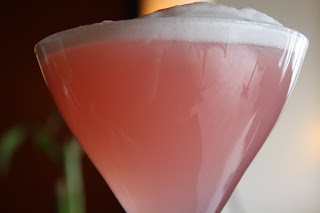
So I decided to showcase my newly bottled handmade limoncello by shaking a few ounces of it with a splash of cranberry juice, a dash of Peychaud's bitters and a teaspoon of egg white powder to pay tribute to the old ways of cocktail making with current responsibility.


This week's food special wasn't inspired by my trip, but I have been slowly plotting it out for awhile now.

I wanted to do a take on veal fricassee, but with the it being officially spring I didn't want to have a heavy stew so I took a different approach. By using a cut called the eye round I was able to make thin, tender slices that I dusted with a combination of rye flour and cornstarch before sauteing in clarified butter instead of the typical braise. The usual vegetables for fricassee are carrots, peas and button mushrooms, but I though a little change-up would be nice, so I sauteed shelled edemame, shitaki mushrooms, spring onions and some thinly sliced white asparagus that has just come into season. I also simmered slices of golden beets with a touch of saffron to create a beautiful stock that I used to cook some fragrant jasmine rice. Finally, to represent the cooking liquid I made a rich sauce by reducing beef stock with tomato and red wine and thickening it to order.


With Love,

Cheffrey

Wednesday, March 24, 2010

Horale

Yes, I do realize that this blog is supposed to be in English, but with this week's special, I couldn't help it. The blog title, horale, is Spanish slang that usually translates to "right on!", like when I assemble a really good special for the first time and it comes out even better than I had hoped, and I turn to my cook Alejandro and say "Horale!" while nodding my head; he knows. He knows that i've made it chingon - the best.

I'm always asked where I learned Spanish, and I always respond with the same lousy joke "in school", but while I was taught the words by a teacher, I didn't speak the language until I worked in kitchens in New York City, and even more so when I became chef there. The funny thing is, the more you learn the more you become apart of the culture, and before long I started to notice the Latino influences seeping into my cooking style. Nowadays my tastes are ever-changing, and I usually add those influences in subtle moderation, but with a new taco truck popping up everywhere in Seattle, I know that I can find a good audience for my take on comida authentica.

For those of you who wish to disparage how much Mexican cuisine has become apart of our culture, all you need for proof is to visit your local grocery store, like the banana leaves or corn husks at the QFC on Broadway or the masa harina (corn flour) at the Safeway on 15th Ave, the essential ingredients for tamales, but for me that's not enough.

To fill my tamales, I first slow-cooked chicken thighs over applewood logs, allowing for a good, smoky flavor without being overbearing. Once cooled I mixed the shredded meat with onions, garlic, oregano, chicken stock and other spices that made up the core for the tamale. For the filling of the tamale I went traditional, but with extra flavor by slowly mixing the masa harina with pork fat until it was crumbly like making pastry dough and then I added just enough rich chicken stock to bring it all together. I used banana leaves to wrap the meat and dough into one very large ubertamale. While they steamed for two hours I prepared the remaining components.
For the first component I needed a sauce, so I went with a French-Spanish hybrid, faulty gas pedal excluded (yuk, yuk!). I started my ragout by first searing off diced chorizo sausage in butter, and then I added chopped onions and garlic, chicken stock, Spanish paprika, smoked paprika, chipotle powder (which technically is another type of paprika...) tomatoes and parsley. Once thickened and seasoned I set the ragout aside to cool.

To balance out the spicy ragout I decided to use another winter vegetable favorite before it's gone - the rutabaga. This misunderstood yellow turnip is absolutely outstanding when peeled and simmered in a little half and half and water, and it is silky smooth after you strain it and puree it with just a touch of its own cooking liquid. Here, it acts as a buffer between the smoky tamale and the spicy chorizo ragout.


To continue on with the Latino theme I decided to concoct a punch of sorts to pay tribute to some of this lovely afternoon sun that we have been receiving lately.

Tamarind is a tropical sour fruit that comes from a pod, and when the pulp of that fruit is mixed with a little sugar it has a delightfully balanced of flavor. For this cocktail I mixed a little tamarind concentrate with some leftover kumquat puree and a little fresh lime juice, and, once mixed with a hefty portion of rum it makes for really refreshing sipping drink - almost like you were on the beach in Oaxaca, Mexico!!

Con Mi Amor,


Cheffrey